It can’t be that difficult. When Daniela Roeper first heard about icing on wind turbines, she decided to solve this problem in no time at all. A few years, several patents and a company foundation later, we asked: Has the Canadian got the ice on the blade under control?
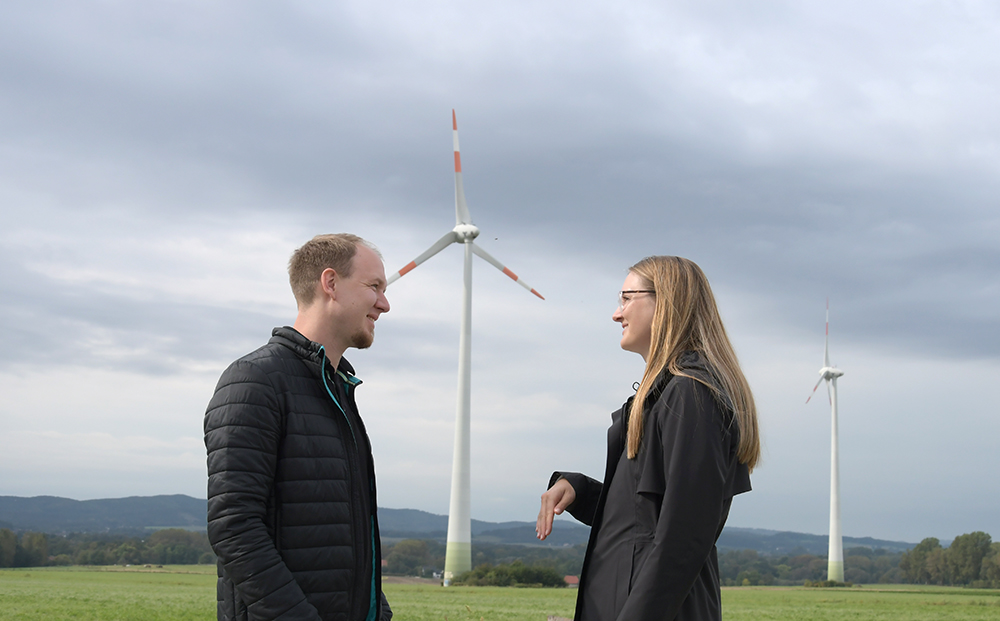
The interview with Daniela Roeper could also have been held in German. After all, the Canadian company founder’s grandparents come from Detmold in East Westphalia. Nils Lesmann knew that. And since the long-standing expert in the Phoenix Contact wind team knows almost everyone who is at home in the wind industry, he knew and took the opportunity for an interview that presented itself during a visit from the Canadian.
UPDATE: Daniela, how did you come up with the idea of working on the development of ice on wind turbines?
I studied machine building and worked for companies in the Canadian wind energy industry during my semester breaks. That’s how I became interested in the icing of wind turbines. After all, renewable energies are also conquering new areas here in Canada, especially those further north. In addition, the height of the turbines is increasing, so that icing is also becoming an issue for temperate latitudes.

UPDATE: Now recognizing a technical problem does not immediately lead to the founding of a company …
That’s probably genetic. My grandparents here in Detmold were already self-employed, and my father is also an entrepreneur. With a dose of courage and the support of a state-funded program for start-ups, I got started after finishing my studies in 2016.
UPDATE: And then success came almost by itself?
It would be nice (laughs). It would be nice. Surprisingly, the technical implementation was the smaller problem. An initial solution was ready in 2017. Our aim was to develop a system that could be retrofitted to existing windmills as easily as possible without having to remove the blade. And this retrofit shouldn’t take more than a week. In Canada, many wind farms have been built without having thought about the issue of ice beforehand.
The need of the operators is really great. Ice on the blades means standstill, which in turn means zero yield. So we also found operators on whose turbines we could carry out our tests.
Nils Lesmann: How do you get hold of systems on which you can carry out such tests? They have to turn and generate revenue. Any downtime is really expensive, especially for small start-ups …
In fact, this is one of the biggest challenges for all new technologies. Everything went smoothly in the laboratory at the university. Distributing the heating power across a rotor blade is not so trivial, it requires a lot of know-how and simulation software. Initially, we worked with free programs from the university and developed simulation processes that can map the thermal and flow conditions in the rotor blade.
But the real challenge is to install such systems on site and develop techniques for them. And to make the whole thing durable enough to work on a turbine for a long time.
Details such as the installation in the blades were difficult. The conditions in a rotor blade in the harsh environmental conditions in the far north are extremely challenging. For example, the centrifugal forces in the damp and cold environment are so great that the plugs of our systems sometimes simply opened during operation. This meant that the heating system, although correctly installed and ready for operation, was not operational. You only notice something like this when the system is in operation.
You’re right, of course: you can’t try out wind systems at will. It is to be expected that a test will not be successful. But you shouldn’t approach the operators of wind turbines too early with immature technology. The expectation is that the systems will work. In return, a calculated standstill and thus a loss of yield is accepted. However, this cannot be repeated indefinitely.
UPDATE: What makes the Borealis solution different from other blade heaters?
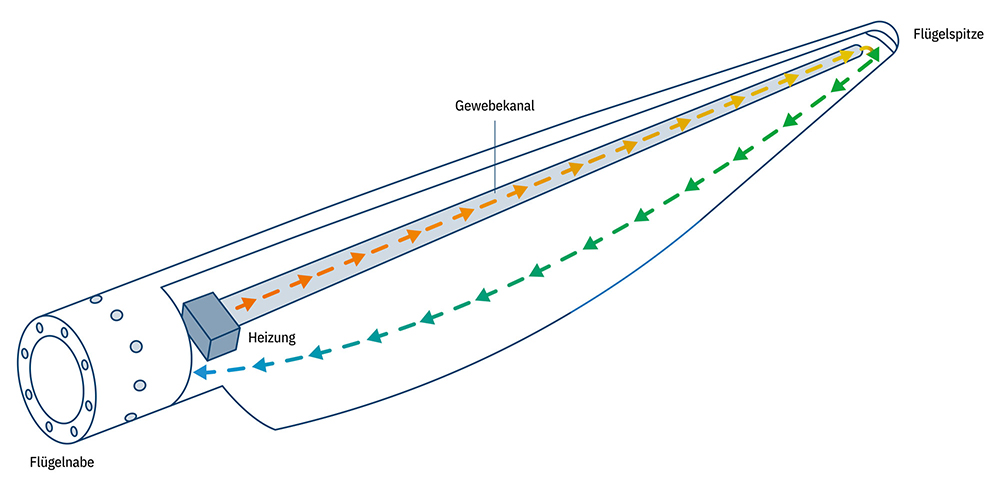
We blow warm air into the leaves and let it do its work for us. But heating alone is not enough. Normally, the centrifugal forces in the blade would simply push the cold air, which is heavier than the warm air, into the tip of the blade. Speeds of up to 400 kilometers per hour are reached at the tip of the blade, where enormous centrifugal forces are at work. The trick is the air flow. We have developed very complex flow models to guide the air in our favor.
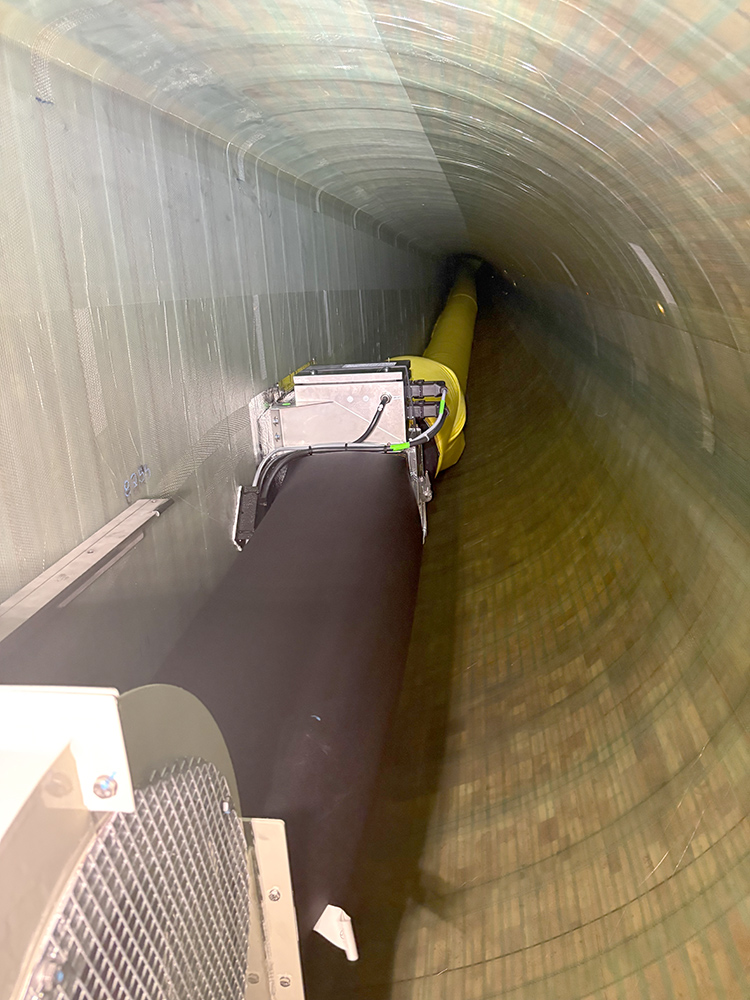
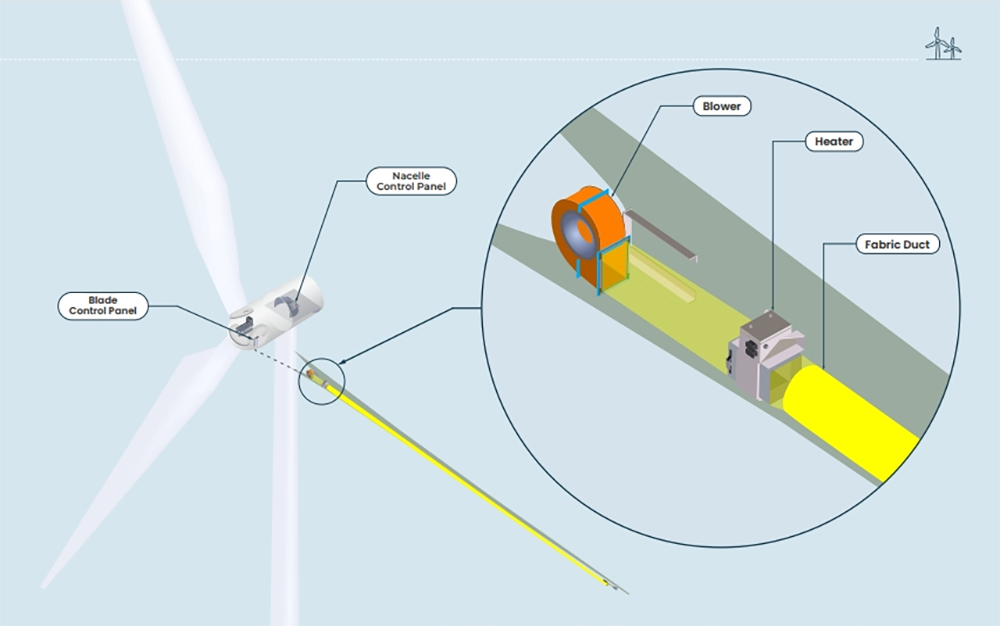
We laminate tubular fabric channels into the rotor blades. We then use fans attached to the base of the blade to blow warm air through these channels into the tips of the rotor blades. The heater itself is located centrally in the nacelle. The fans are very powerful and generate a relatively high pressure to circulate the air. This is also the difference to other, similarly operating systems, which work with significantly less power. In this way, we achieve air exchange and bring the warm air to where ice is most likely to form – at the front of the leaves and the tips. Because these are precisely the places that pass through the upper layers of air and trap the crystals.
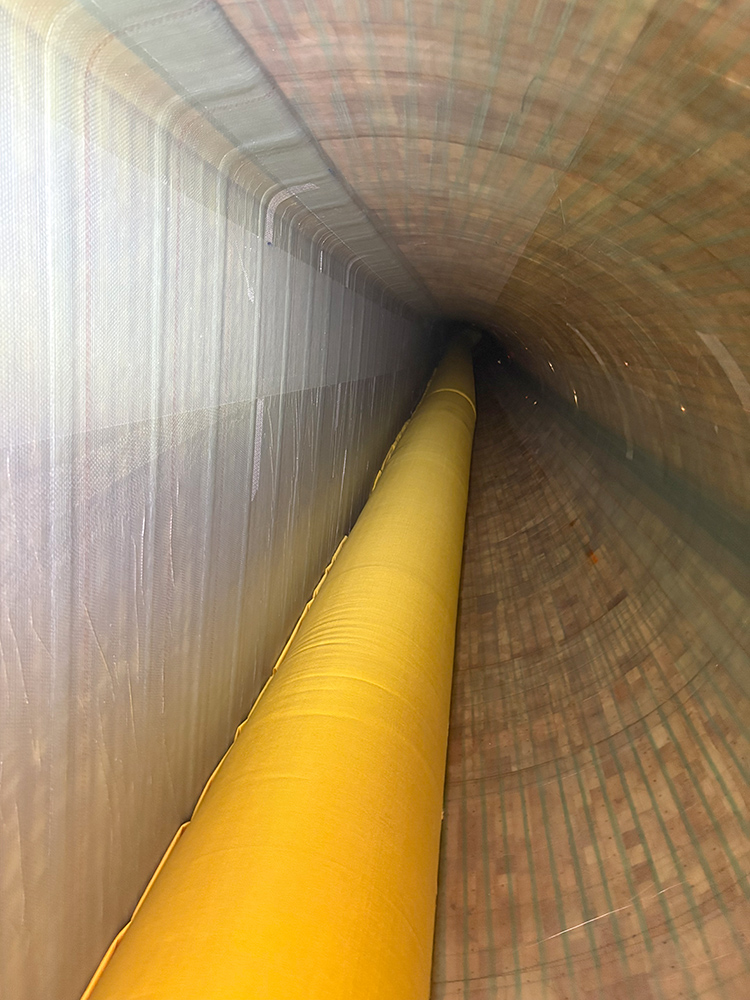
When the wind turbine turns, our fabric ducts are subjected to around twenty times the pressure. We had to carry out extensive material tests for this alone. The material has to be able to withstand the vibrations. It also has to be fire-retardant. We had to find out whether the fabric absorbs moisture and how much of it, because then the weight changes again and with it the forces acting on it. Initially, we supported the fabric channels with fiberglass poles, similar to a tent. The disadvantage was that they became relatively heavy. At the beginning of 2024, we developed a new system in which we installed a bracket in the tip of the blade and tensioned the heating system like a rope. This is lighter and even easier to install. The rotation presses the glued-in holding point, where the rope is tensioned, into the tip and fixes the system. The current system consists only of fabric, which weighs around ten kilograms.
Nils Lesmann: Adhesives are a topic in themselves, aren’t they?
Exactly (sighs). We tried hundreds of adhesives until we found the right one. The problem is that the adhesive not only has to set in cold temperatures, but also in a damp and dirty environment. And the processing time has to be right, because you can’t go straight to the tip to glue it there manually. The positioning process alone takes around 30 minutes.
But the stuff really is phenomenal. Once glued down, the adhesives simply last forever. Woe betide you if you stick it to yourself …
UPDATE: What energy input is required for such a heating system?
In a 3 MW wind turbine, we need around 100 kW for fans and heaters for operation. This is a negligible input if the turbine would otherwise be at risk of shutting down due to ice formation. If the blades of the turbine repeatedly sweep through low-hanging clouds, ice crystals accumulate on the edges of the blades at low temperatures. This can lead to the formation of centimeter-thick layers of ice. These can be thrown off and thus become a danger to passers-by. But they also affect the aerodynamics of the leaves themselves. This causes the loads to collapse, resulting in high losses of up to 60 percent in operation.
Nils Lesmann: Just two millimetres of ice thickness are enough to tear down the aerodynamic properties of the blades. That’s around 20 to 50 percent yield loss. To counteract this, ice formation must be detected as early as possible.
We achieve 40 to 50 degrees at the tips with our warm air duct. We also always heat all three blades. There are systems that only heat one blade if ice infestation is detected there. And that’s always too late.
We sold and installed our first systems in Canada in 2019. They are still working. We used a lot of Phoenix Contact components for this, right down to the use of PLCnext Technology.
UPDATE: Since then, the world has known Borealis and Daniela Roeper?
Well, yes. We have grown slowly since then. We are focused on retrofit plants, because that’s where we work with existing plants. You need a lot of capital to get manufacturers to invest in new types of plant. It’s hard enough to convince operators of existing systems, which all have to deal with ice formation, that a one-off investment will pay for itself after a short time. But explain that to a Texan investor or operator who runs a wind farm in the Nordic regions!
We always see astonished faces when we calculate the effects of ice formation. This even applies to Canadian operators. They also assume false loss rates. They sit in their warm offices in Quebec and can’t believe that ice formation causes such losses, especially in relatively mild but very wet winters. This can quickly amount to hundreds of thousands of Canadian dollars or more per wind turbine.
UPDATE: What is the situation today?
In 2023, we were acquired by the Danish company Fabricair, which also manufactures our fabric hoses. I am very happy about this, because it allows us to realize completely new business models. We no longer sell our heaters as stand-alone products, but offer them as a kind of service. The first year was even a kind of maintenance contract. We would never have been able to do that with our own financial resources.
We are still only represented in Canada. But we are working on our first projects in Sweden.
Borealis Wind
Phoenix Contact Rotorblattüberwachung